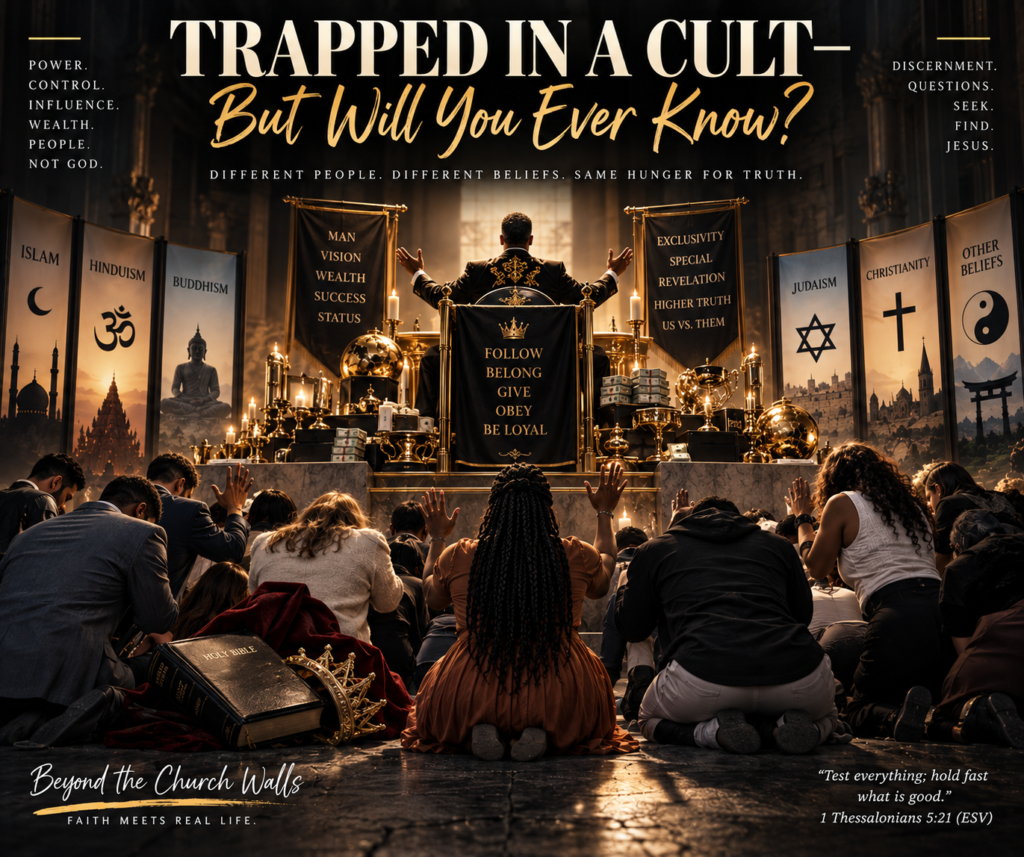
Look around the world, and you will find countless religions, denominations, traditions, and belief systems. Christianity, Islam, Judaism, Hinduism, Buddhism, and many others all contain people who sincerely believe what they have been taught. Even within these religions, branches, denominations, interpretations, and practices differ. Within Christianity alone, there are Baptists, Pentecostals, Catholics, Methodists, Seventh-day Adventists, non-denominational churches, and many others.
Some religions believe Jesus is God. Others recognize Him as a prophet, teacher, or historical figure. Some believe in modern-day prophets and apostles, while others reject them. Some people worship one God, some worship multiple gods, and others do not believe in God at all. Yet people across the world are convinced that what they believe is true. So, who is wrong and who is right? How would you know if what you have believed your entire life was wrong? That is the uncomfortable question.
Many people inherit religion before they are old enough to question it. You may be born into a Christian household, Muslim household, Hindu household, Jewish household, or another religious environment. You learn what your family believes, attend the places where they worship, participate in their traditions, and are taught what is considered truth. For many people, questioning those beliefs can mean questioning their family, community, culture, and everything they have ever known. This is why deception is not always easy to recognize.
From a Christian perspective, however, truth cannot simply be determined by tradition, popularity, family, culture, or the words of a religious leader. It must ultimately be tested against the Word of God. Ephesians 4:11 speaks of apostles, prophets, evangelists, pastors, and teachers. These roles were given for the building up of the body of Christ. But what happens when spiritual authority is used for the wrong reasons? What happens when people begin following the person with the gift more than the God who gave it? This is where discernment becomes necessary.
Scripture repeatedly warns believers about false prophets and false teachers. Jesus Himself said, “Beware of false prophets, who come to you in sheep’s clothing but inwardly are ravenous wolves” (Matthew 7:15, ESV). Greco (2018) explains, “Peter tells us that false teachers can also arise from within the community of believers, bringing doctrine that is destructive and poisonous.” The frightening part about this warning is that false prophets do not always look false. They may know Scripture. They may preach well. They may have charisma, influence, titles, followers, and seemingly powerful ministries. Yet none of those things automatically prove that someone is sent by God. This is why Christians must know Scripture for themselves.
There is a dangerous difference between respecting spiritual leadership and idolizing spiritual leadership. Pastors, teachers, prophets, evangelists, and other leaders should always point people toward Christ, not themselves. When a ministry becomes centered around one person’s authority, personality, revelation, or status, believers should pay attention. No pastor, prophet, apostle, bishop, teacher, or religious leader deserves the worship that belongs to God.
Paul addressed this type of misplaced loyalty when believers began identifying themselves according to the leaders they followed: “I follow Paul,” and “I follow Apollos” (1 Corinthians 3:4, ESV). Paul redirected their attention by reminding them that these leaders were merely servants through whom they came to believe (1 Corinthians 3:5). That same question should challenge Christians today: Are you following Christ, or have you become more devoted to the person teaching you about Christ?
For some people, unhealthy religious environments are all they have ever known. They may have been born into them, raised in them, pressured into them, or entered them during a vulnerable season of life. When something has been presented as “God” your entire life, questioning it can feel like questioning God Himself. But questioning a religious leader is not the same as questioning God. Testing teaching against Scripture is biblical. First John 4:1 tells believers, “Do not believe every spirit, but test the spirits to see whether they are from God” (ESV). Discernment requires us to examine what we are hearing, who we are following, and whether their teaching agrees with Scripture.
A religious group may promise belonging, protection, prosperity, status, spiritual power, or even special access to God. But from the Christian perspective, none of these things can offer eternal life. Jesus made an exclusive claim: “I am the way, and the truth, and the life. No one comes to the Father except through me” (John 14:6, ESV). If Jesus is who He says He is, then truth cannot simply be whatever we were raised to believe. Truth cannot be determined by what is most popular, what feels most comfortable, or what a religious leader tells us. It must come back to Christ.
You can convince yourself that you are worshiping God. You can attend a religious service every week, serve faithfully, give money, know religious language, follow traditions, and defend your spiritual leader, and still need to ask yourself a difficult question: Who is actually sitting on the throne of my life? And maybe there is an even harder question: If everything you were taught about God were wrong, would you be willing to seek the truth even if it cost you everything you had always known?
For Christians, that examination must begin with us. We cannot point toward deception in the world while refusing to examine what is happening inside our own churches. If a human being has been elevated to a place that belongs to Christ, something has gone terribly wrong. Christianity was never supposed to be about worshiping the messenger. It has always been about Jesus.
Leave a Reply